• About
  • Blog Posts

waterjug

~ Tagalog (Filipino) Translations of Poetry from English and Vice Versa. Run Out of Love and Passion, Never Out of Words.

waterjug

Tag Archives: Filipino

Hango: Tula ng Bagong Taon (Excerpt: New Year’s Poem by Margaret Avison)

03 Friday Jan 2025

Posted by Su Layug in Poetry Translation

≈ 4 Comments

Tags

2025, birds, cosmic wisdom, death, Filipino, Filipino translation, flourishing, grieving, lark, life, Margaret Avison, mindfulness, new year, Poetry, recovery, renewal, snow, starling, swallows, Tagalog, Tagalog translation, translation, Winter

Translated to Tagalog / Filipino by Su Layug
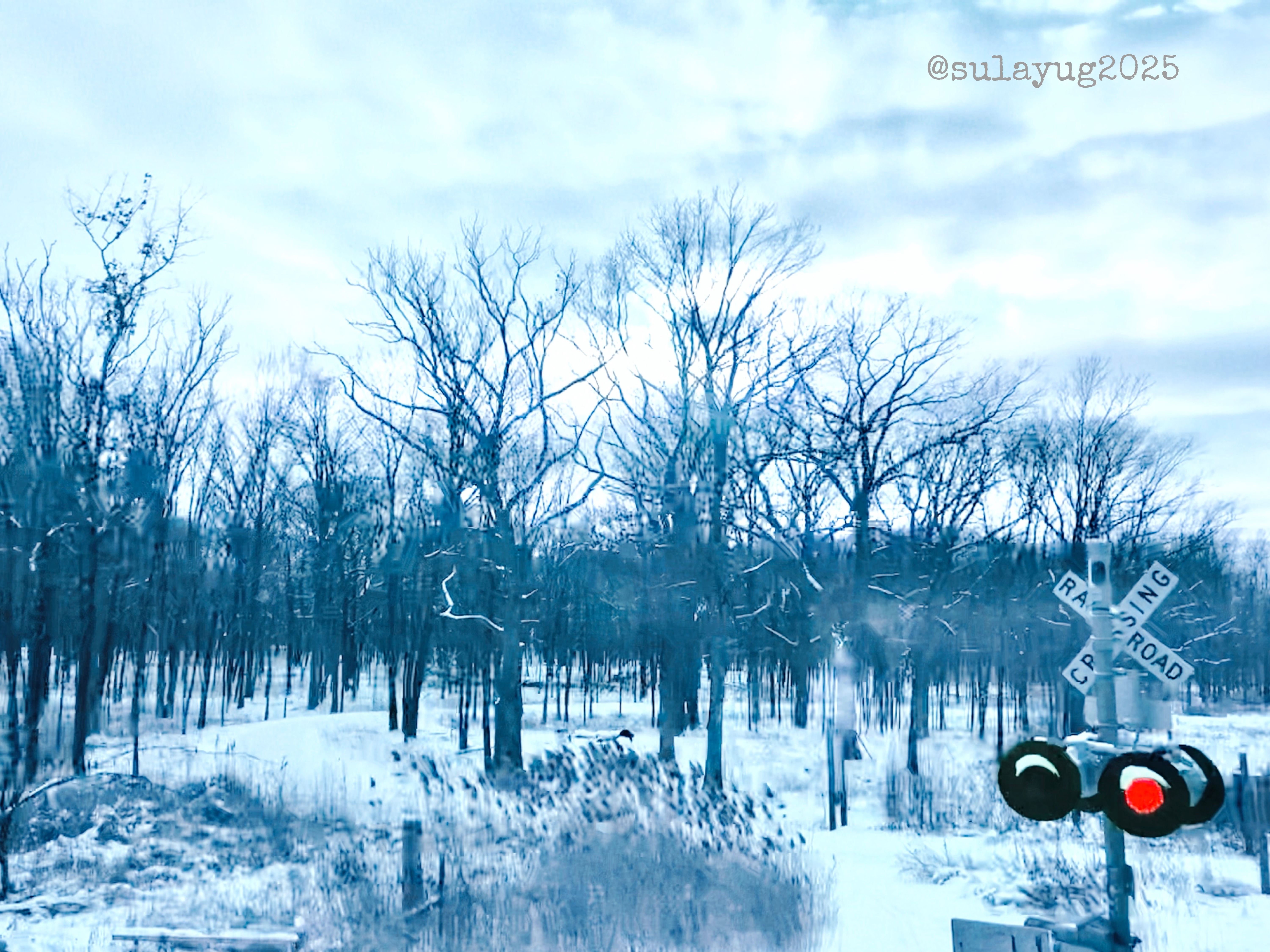


          Naaalala ko
Ang bigat-balaning halimuyak ni Anne, ang di-matinag na puntod
Na mumunti lamang ang nakukupkop ng lamig;
Magiliw kong binabakas ang mga bungo at brasong buto
Mga anyong kinahig ng mga kulansiyang at langay-langayan, sa pagkuha nila ng rabaw,
At ang mahabang silo ng amihan
Nililinaw ang pagkurba ng arko nito, mula sa bituing Arcturus
Hanggang sa laryong kanto ng patyo,
At sa pasimanong walang-galaw.
Malumanay at makatarungang kasiyahan
bilang nilalang ang makamit mula sa kalawakan
Itong maligamgam at napagnanahanang kalooban
Na tahimik na sumasalamin sa sinag
ng (harayang) niyebe, at ng bagong taon.
             I remember   
Anne’s rose-sweet gravity, and the stiff grave
Where cold so little can contain;
I mark the queer delightful skull and crossbones
Starlings and sparrows left, taking the crust,
And the long loop of winter wind
Smoothing its arc from dark Arcturus down
To the bricked corner of the drifted courtyard,
And the still window-ledge.
Gentle and just pleasure
It is, being human, to have won from space
This unchill, habitable interior
Which mirrors quietly the light
Of the snow, and the new year.

Translator’s notes:

One of the challenges of translating from a language of one climate zone to another of a different climate zone is the concept of the seasons. The original English was clearly written in the context of the temperate zone of the northern hemisphere where snow commonly exists at the turning of the year, whereas Filipino / Tagalog is a language from a tropical climate. Two considerations:

1) the migration of birds, which is, to me, a central concept in the passing of time and the subtle shifting of sentiments, whether natural or induced, is seen by this translator as crucial in the portayal of emotional flourishing–and survival. The lark is perceived as the common-and-yet heroic bird, rising at the dawn of day, a natural bringer of joy with its songs, cited in many poetic lines, such as Shakespeare’s Sonnet 29. The starling, in contrast, is the less-than-heroic one which tends to be destructive to fruits and other vegetation, and yet is remarkable in its mimicry of other birds and sounds, as though such pretense is crucial for existence, even survival.

The translation, to Filipino, however, does not equate to the actual names of the birds. Though also migratory, the Philippine starling (kulansiyang) remains the less-than-heroic one, with its noise-making as its most recognizable feature, though not the mimicry of the northern hemisphere starling. The langay-langayan, which is the equivalent of the swallow (and not the lark), is the more graceful, poetic bird in this translation. It is usually associated with grace, hope, and renewal.

2) In translating “snow” I have opted to include the notion that “niyebe” (Spanish-derived word for “snow”) may be imagined as signified by the parenthesized word “haraya” (imagined). With this duality, the context then shifts back-and-forth from the experience of a Filipino who may have never left the Philippines, but is intellectually familiar with snow, to that of a Filipino who has migrated to a country where snow is a real experience. In either case, the experience of snow as part of the awakening, and/or survival/recovery/grieving/flourishing/renewal process, in its complexity, is real, whether to a migratory or a colonized mind, or both

The full English poem can be read here: https://www.poetryfoundation.org/poems/51733/new-years-poem?utm_source=Poetry%20Foundation&utm_campaign=bc1922be67-NO_TITLE&utm_medium=email&utm_term=0_ff7136981c-bc1922be67-185698833&mc_cid=bc1922be67&mc_eid=3b56d6ba23
Share this:

  • Share on X (Opens in new window) X
  • Share on Pinterest (Opens in new window) Pinterest
  • Share on LinkedIn (Opens in new window) LinkedIn
  • Share on Tumblr (Opens in new window) Tumblr
  • Share on Facebook (Opens in new window) Facebook
  • Email a link to a friend (Opens in new window) Email
  • Share on Reddit (Opens in new window) Reddit
Like Loading...

Hango: Salamin ng Lumbay (Excerpt: Melancholy’s Mirror by Robert Cording)

11 Sunday Feb 2024

Posted by Su Layug in Poetry Translation

≈ Leave a comment

Tags

death, Filipino, Filipino translation, grief, literary translation, melancholy, Poetry, Robert Cording, Tagalog, Tagalog translation, translation

A Translation from English to Filipino by Su Layug

Kabilang ako ngayon sa sarili kong anatomiya ng lumbay—

Sa tagal nitong paghihintay sa hindi mangyari-yari

Sa pagtrangka nito sa kinabukasan. Sa pagkaalam nito

sa lagpas-kamatayan na hanggang doon na lang

ang alam. Ang pagkainutil nitong kumpletuhin

ang buhay na basta na lamang nagwakas. Imahe ni Durer,

may pakpak ngunit paralisado, napupung-aw, nakalatag

ang mga kagamitan sa harap niya, ngunit hindi makalikha. Ang mga salitang ito

na wari’y mga insektong nagkukubli ngayong dapithapong taglamig.
I belong today to my own anatomy of melancholy—

its long wait for what never happens.
Its shut down of the future. Its after-
knowledge of death that knows no more
than it did before. Its inability to complete
a life that simply ended. Dürer's figure,
winged but paralyzed, moping, tools spread
before him, but unable to create. These words
that lurk like insects this winter late afternoon.

Translator’s Notes:

1 “Hindi mangyari-yari” — the repetition of the root word, “yari” (to happen) at the end denotes the (non-) fruition of the action verb “happen.” (“that never happens”). An alternative is to say “hindi mangyayari” (will never happen) but the earlier phrase, “hindi mangyari-yari” suggests a recurring wish for something to happen, and the recurring end-result of that something never happening.

2. What I found especially difficult to translate are the lines, “Its after-/ knowledge of death that knows no more / than it did before.” The question arises: what does “that” refer to?” Does it refer to “melancholy,” to which the persona belongs to, and thus represents them? Or does it refer to “after-knowledge” (that knows no more than it did before)? I took the liberty of interpreting “that” as referring to “melancholy” which existed before and after the death being talked about. Thus, the Filipino translation, “sa kaalaman sa lampas-kamatayan” (the knowledge of (what is) beyond death) “na hanggang doon na lang ang alam” (which is its (melancholy’s) limit of knowing)

3. Through Cording’s article (a personal essay, its link below), which I found online after writing this translation, we can confirm that this poem is an autobiographical one — that, indeed, it refers to the death of Cording’s son. The poem refers to the visual artist Albrecht Dürer‘s work Melencolia (1513/1514) in the last stanza. The grief of the persona due to the death of his son is juxtaposed with his grief of not being able to create, juxtaposed with the realization that his son, himself, will no longer be able to create, his life having been taken too soon.

4. I chose to say, “Filipino translation,” rather than “Tagalog translation” because I chose to use the word, “napupung-aw” (moping, being melancholic) which is not Tagalog, but Bicolano — the native language of my late mother. I wish I learned her language more.

This is the link to the whole poem in English: https://poems.com/poem/melancholys-mirror/
This is the link to Robert Cording’s personal essay, In the Unwalled City: https://imagejournal.org/article/in-the-unwalled-city/

Share this:

  • Share on X (Opens in new window) X
  • Share on Pinterest (Opens in new window) Pinterest
  • Share on LinkedIn (Opens in new window) LinkedIn
  • Share on Tumblr (Opens in new window) Tumblr
  • Share on Facebook (Opens in new window) Facebook
  • Email a link to a friend (Opens in new window) Email
  • Share on Reddit (Opens in new window) Reddit
Like Loading...

The Roses Bleed

15 Sunday Oct 2023

Posted by Su Layug in Filipino, Micropoetry, Poetry Translation, Tagalog, Twitter Poetry

≈ Leave a comment

Tags

Autumn, Filipino, Filipino translation, poem, Poetry, Tagalog, Tagalog translation, Visual Art

(in English and Tagalog)

The Twitter poetry tradition goes back to when the then-Twitter (now X) platform posed a challenge to poets to write within its restrictive 140 characters, to when the character count expanded to 280, and to now, when the longer form is allowed for premium subscribers.

I continue to write in the restrictive form of 280 characters or less, being used to delivering poetic thoughts in bursts of Tweets, albeit they are no longer called that.

As a Tagalog translator, I (human) also translate my English tweets to this Philippine language, constantly comparing it to the renditions of Google Translate or Bing Translate, which are readily available on The X platform, itself. The evolution of AI in translation is part of my self-study as a translator and as a poet.

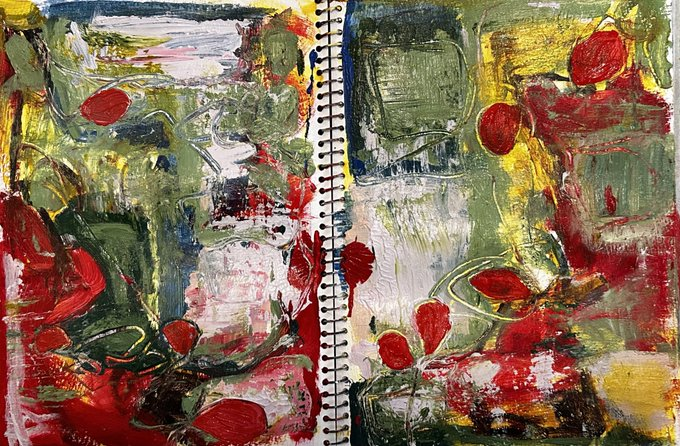
“Rose Gardens” (mixed media on watercolor paper) by ThompsonNFT on Twitter / X with the author’s permission https://twitter.com/thompsonNFT/status/1713194138869387659/photo/1

The Roses Bleed 

onto the page of autumn
where bleeding is allowed
with abandon
in grief, in passion, in remorse --
or to let stand still
what briefly was or what could've been
in a tiny light --
that it may perchance, shine --
another time. Again.

~ Su Layug
Nagdurugo Ang Mga Rosas

sa pahina ng taglagas
kung saan hinahayaan ang pagdugo
nang walang pakundangan
nang dahil sa dalamhati, pusok, pagtitika --
o upang patirikin lamang
ang isang saglit, o ang isa sanang saglit --
nang harinawa'y, 
isang araw
ito'y muling magningning.

~ Su Layug

Share this:

  • Share on X (Opens in new window) X
  • Share on Pinterest (Opens in new window) Pinterest
  • Share on LinkedIn (Opens in new window) LinkedIn
  • Share on Tumblr (Opens in new window) Tumblr
  • Share on Facebook (Opens in new window) Facebook
  • Email a link to a friend (Opens in new window) Email
  • Share on Reddit (Opens in new window) Reddit
Like Loading...

NOTES on Literary Translation: Hesitate (excerpt)

17 Monday Oct 2022

Posted by Su Layug in creative writing, Filipino, Poetry Translation

≈ 2 Comments

Tags

#AI, #AIart, Filipino, Filipino translation, poem, Poetry, Tagalog, Tagalog translation

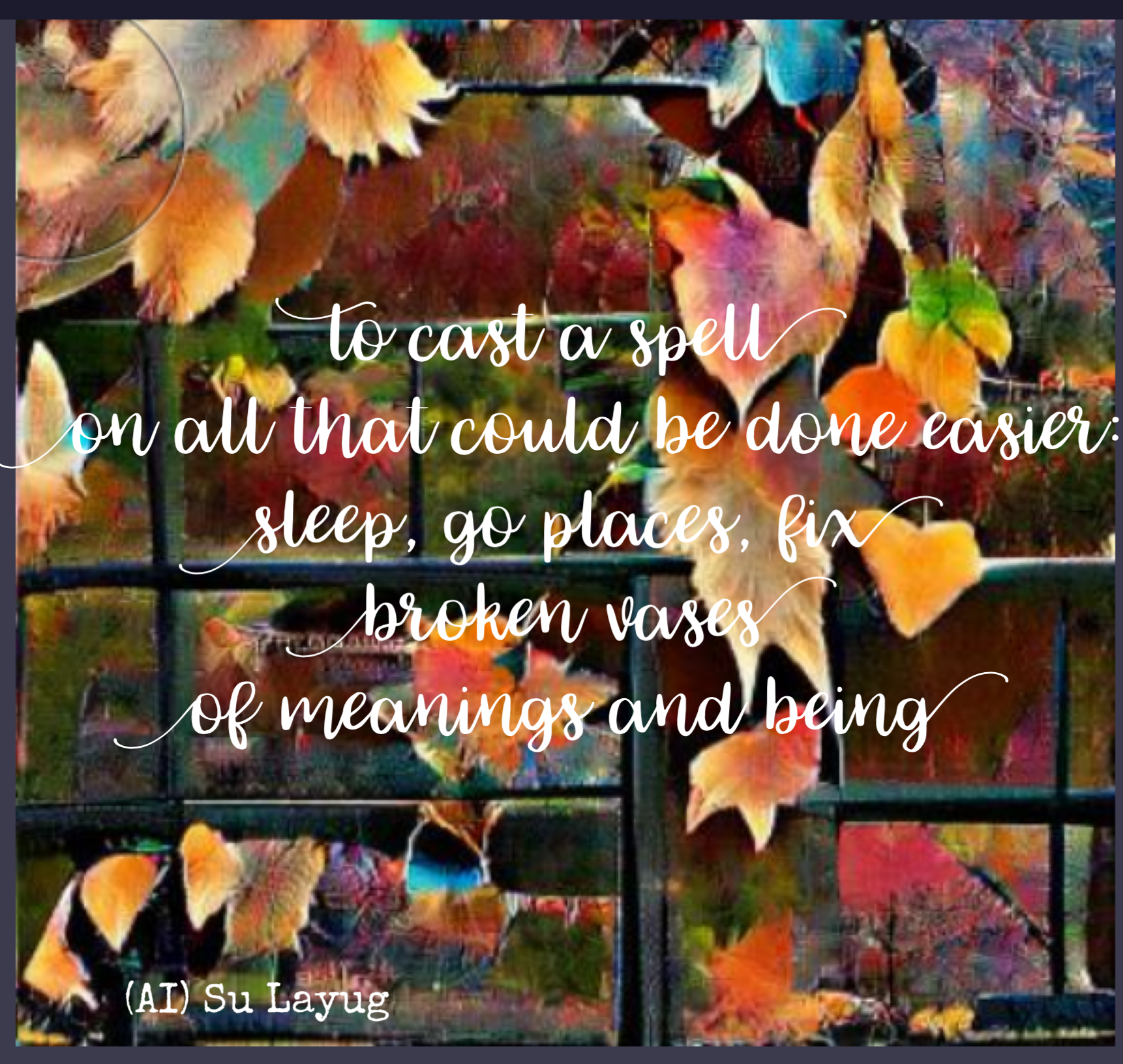
English and Tagalog excerpt from a poem by the author inspired by an AI image generated from a photograph by the same creator

To cast a spell
on all that could be done easier:
to sleep, to go places,
to fix
broken vases
of meanings and being

©su layug (image and verse may be reposted with reference to the creator, Su Layug)
Ang maghasik ng engkanto
sa lahat ng maaaring
gawin nang mas madali:
ang matulog, ang maglakbay,
ang ayusin
ang mga nasirang sisidlan
ng mga kabuluhan
at pagiging nilalang

©su layug (image and verse may be reposted with reference to the creator, Su Layug)
----------------------------------

Two words that were challenging to me, even as I knew what I meant in the original English poem:
  1. “vases” — the literal translation is “plorera” which is derived from the Spanish “florera” = container for flowers. By using “sisidlan” (container), instead, the reference becomes “container (of different things, both literal and abstract).” The word “vase” here is used in the Greek sense of vase being the same as pot or vessel. https://www.panoply.org.uk/about-vases
  2. “being” — There is no one word in Tagalog/Filipino that is self-contained in its meaning and connotation that translates back to “being” (the state of existing, or of being alive or real). The word “pagiging” (the state of something) needs to be followed by a noun: “being ___ (human, somebody, a creature). I chose “pagiging nilalang” (being a creation/ being human). The root word “lalang,” which means “create,” leads us to the basic ontological notion that a person is “created” by someone/something/a force beyond such being, an epistemological belief rooted in both pre-colonial and post-colonial Filipino spirituality.

Share this:

  • Share on X (Opens in new window) X
  • Share on Pinterest (Opens in new window) Pinterest
  • Share on LinkedIn (Opens in new window) LinkedIn
  • Share on Tumblr (Opens in new window) Tumblr
  • Share on Facebook (Opens in new window) Facebook
  • Email a link to a friend (Opens in new window) Email
  • Share on Reddit (Opens in new window) Reddit
Like Loading...

Filipino / Tagalog Translation of Emily Dickinson’s Poem 1292

24 Saturday Sep 2022

Posted by Su Layug in Poetry Translation

≈ Leave a comment

Tags

emilydickinson, Filipino, Poetry, Tagalog translation

AI image created by Su Layug
In this short Life that only lasts an hour
How much - how little - is within our power
~ Emily Dickinson

Tagalog / Filipino translation by Su Layug:

Dito sa maikling Buhay na isang dali lamang
Napakalaki - napakaliit - ng ating kapangyarihan

*Translator’s note: I opted to use “isang dali” (one quickness) instead of “isang oras” (one hour) to emphasize the relativeness of how long a lifetime may be. In pre-Hispanic Philippines, time was not measured in seconds, minutes, hours. The measurement of “isa” (one) and “dali” (quick/quickness) is the breakdown of the more commonly used word, “sandali” which means “moment.” In reading the poem, the questions can be asked: How long is a “short life?” How short is a “moment?”

Share this:

  • Share on X (Opens in new window) X
  • Share on Pinterest (Opens in new window) Pinterest
  • Share on LinkedIn (Opens in new window) LinkedIn
  • Share on Tumblr (Opens in new window) Tumblr
  • Share on Facebook (Opens in new window) Facebook
  • Email a link to a friend (Opens in new window) Email
  • Share on Reddit (Opens in new window) Reddit
Like Loading...

Saranggola ni Pepe (Pepe’s Kite) | Lyrics by Nonoy Gallardo (Translated from Tagalog by Su Layug

21 Saturday Feb 2015

Posted by Su Layug in EDSA1, Filipino, International Mother Language Day, Marcos Regime, Mother Language, People Power, Philippines, Poetry Translation, Protest, Tagalog, translation

≈ Leave a comment

Tags

#70's, #Celeste Legazpi, #children's song, #EDSA1, #Filipino song, #kite, #Marcos Regime, #MotherLanguage, #Nonoy Gallardo, #PEOPLEPOWER, #political #opression, #Political poetry, #political song, #Protest, #Songs of Protest, #translation, corruption, Filipino, Filipino-English translation, Philippine poltics, Tagalog, Tagalog #folksong

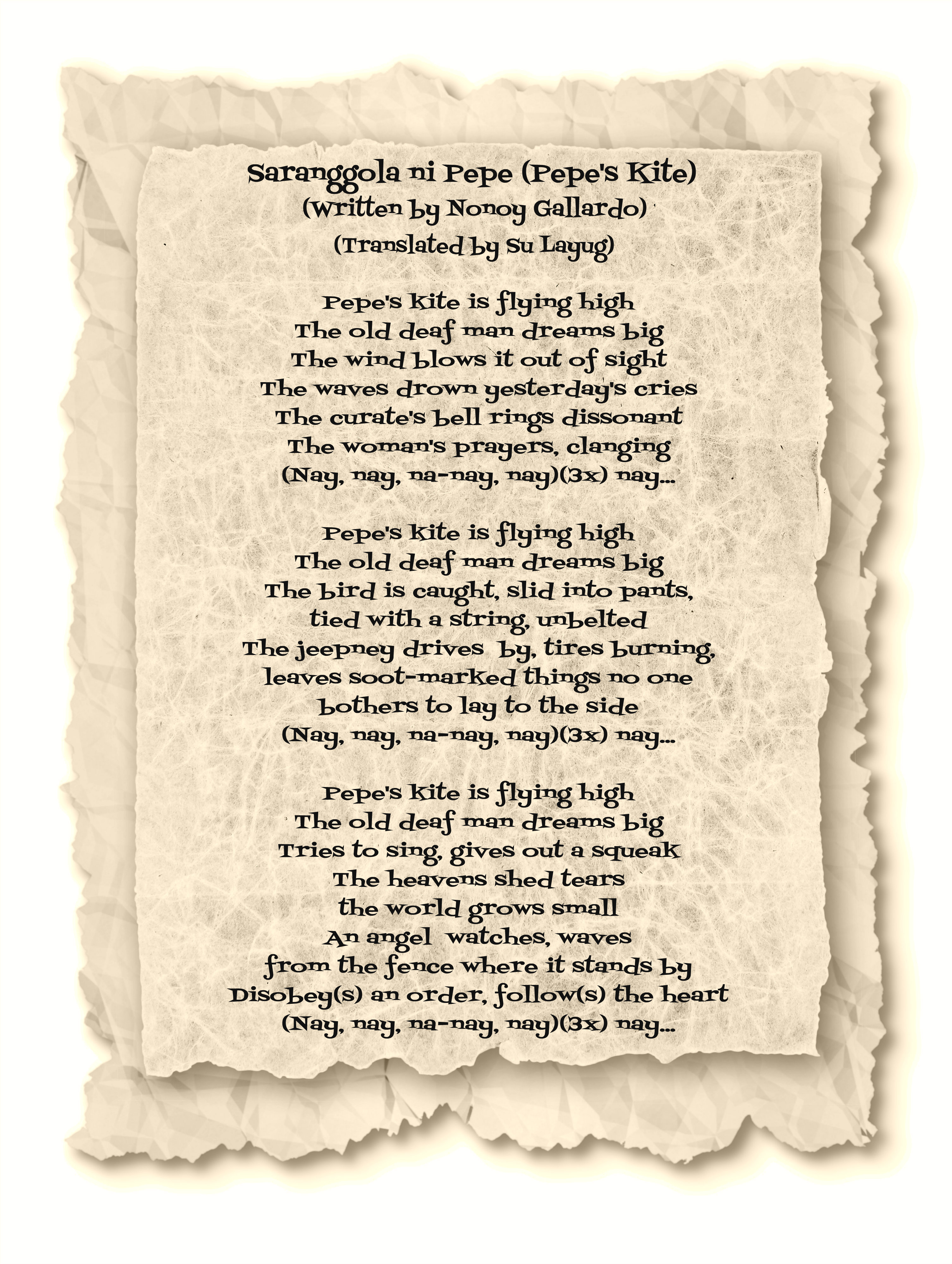
Saranggola ni Pepe
(Lyrics by Nonoy Gallaro, Popularized by Celeste Legaspi)

Matayog ang lipad ng saranggola ni Pepe
Matayog ang pangarap ng matandang bingi
Umihip ang hangin, nawala sa paningin
Sigaw ng kahapon, nilamon na ng alon
Malabo ang tunog ng kampanilya ni Padre
Maingay ang taginting, rosaryo ng babae
Nay…nay…nay…nay…

Matayog ang lipad ng saranggola ni Pepe
Matayog ang pangarap ng matandang bingi
Hinuli ang ibon, pinagsuot ng pantalon
Tinali ng pisi, hindi na nagsinturon
Dumaan ang jeepney at gumuhit pa sa kalye
Mauling ang iniwang hindi na tinabi
Nay…nay…nay…nay…

Matayog ang lipad ng saranggola ni Pepe
Matayog ang pangarap ng matandang bingi
Pinilit umawit, ang naglaro’y isang ingit
Lumuha ang langit at ang mundo ay nanliit
Kumakaway sa bakod ang anghel na nakatanod
Sumusuway sa utos, puso’y sinusunod
Nay…nay…nay…nay…

collection of various white note papers on white background.

The song “Saranggola ni Pepe” written by NonoyGallardo, was popularized by Celeste Legazpi in the late 70’s. Its highly visual lyrics and elusive meaning appealed to political activists who, oppressed under the rule of the Marcos regime, could not openly criticize his government, for fear that they could end up “invited” to the military camps and end up like many who were held as political prisoners without due process, and many of whom became “the disappeared.”

Still, never explicitly categorized as a protest song, the folk song elements of this music also appealed to the masses and the children; and it was routinely included in school program performances.  Personally, this song appeals to me in its poetic ellipse — its levels of meaning and interpretations, as versatile and playful as the archetypal kite.

Share this:

  • Share on X (Opens in new window) X
  • Share on Pinterest (Opens in new window) Pinterest
  • Share on LinkedIn (Opens in new window) LinkedIn
  • Share on Tumblr (Opens in new window) Tumblr
  • Share on Facebook (Opens in new window) Facebook
  • Email a link to a friend (Opens in new window) Email
  • Share on Reddit (Opens in new window) Reddit
Like Loading...

Ang Nakasakay (The Rider) by Naomi Shihab Nye (Transl. by Su Layug)

12 Saturday Apr 2014

Posted by Su Layug in Filipino, Naomi Shihab Nye, NaPoMo, National Poetry Month, poem, Poetry Translation, Tagalog, translation, Tumblr, Twitter

≈ Leave a comment

Tags

Azalea, azaleas, bicycle, bike, biking, English poem, Filipino, Filipino poem, Filipino translation, loneliness, Naomi Shihab Nye, roller-skate, roller-skating, Tagalog, Tagalog poem, Tagalog poetry, Tagalog translation, victory

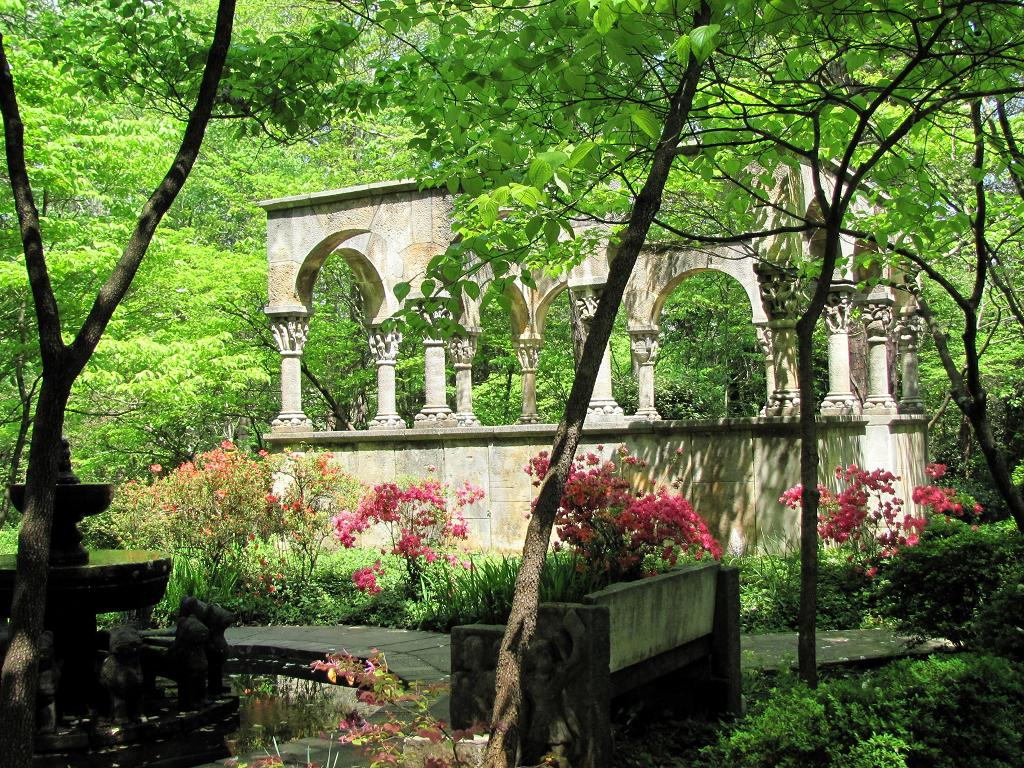
5682332708_2c462ae1d4_b
“Cloister” photo credit/flickr/UniversalPops

Ang Nakasakay

~ Naomi Shihab Nye

(pagsasalin ni Su Layug)

Sabi ng isang totoy
kung bibilisan daw niya ang pag-roller-skate
hindi siya mahahabol ng kalungkutan niya,

ang pinakamagandang dahilan na narinig ko
para magpursigeng maging kampeyon.

Ang minumuni ko ngayong gabi
habang nag-pe-pedal sa King William Street
ay kung uubra rin ito sa bisikleta.

Panalo ‘to! Ang iwanan ang kalungkutan
na humihingal sa isang kanto
habang lumulutang kang libre sa ulap ng kapagdakang mga azalea,
mga pink na talulot na hindi kailanman nakaramdam ng kalungkutan,
kahit na gaano pa sila kabagal malagas.

A translation in response to:

from @april_is a poem a day for national poetry month (April 12, 2009: The Rider, Naomi Shihab Nye) http://t.co/RznrHKhhLu #NaPoMo

— Katharine Garrett Eastman (@notinmy) April 12, 2014

A copy of the original poem from Tumblr blog: A Poem A Day

Share this:

  • Share on X (Opens in new window) X
  • Share on Pinterest (Opens in new window) Pinterest
  • Share on LinkedIn (Opens in new window) LinkedIn
  • Share on Tumblr (Opens in new window) Tumblr
  • Share on Facebook (Opens in new window) Facebook
  • Email a link to a friend (Opens in new window) Email
  • Share on Reddit (Opens in new window) Reddit
Like Loading...

Micropoetry No. 1 “Migration” (Pagdayo)

25 Tuesday Mar 2014

Posted by Su Layug in Chris Hadfield, Filipino, immigration, ISS, Micropoetry, NaPoMo, National Poetry Month, NPR, poem, Poetry Translation, Tagalog, TMMpoetry, translation, Twitter, Twitter Poetry

≈ Leave a comment

Tags

Chris Hadfield, Filipino, Filipino translation, immigration, ISS, Micropoetry, migration, NaPoMo, National Poetry Month, NPM, NPM14, NPM2014, poem, Poetry, Rio Grande, River, Tagalog, Tagalog translation, TMMPoetry, Twitter Poetry

Creating an Ecosytem in 140 Characters (NPR's April 14 broadcast of this poem)

UPDATE: This Twitter poem has been selected and read by poet Holly Bass on National Public Radio’s Tell Me More on April 8, 2014 as part of a month-long celebration of poetry. Please click on the link below for the audio and transcript

National Public Radio Tell Me More #TMMPoetry audio and transcript

The original Tweet of Commander Chris Hadfield to which I respond with micropoetry

Matamoros and Brownsville, where the Rio Grande finally meets the Gulf, at the US/Mexico border. pic.twitter.com/Yb2DmYCasg

— Chris Hadfield (@Cmdr_Hadfield) May 30, 2013

My Twitter poetry response:

Copyright © 2013 2014 Su Layug. All Rights Reserved

marbled waterscape
mosaic of fields—
The Great River
has witnessed birds, seeds, humans—stories
before "migration" was a word@Cmdr_Hadfield

— Su (@su_layug) May 30, 2013

MY Tagalog Translation as #TMMpoetry Tweet:

marmol na tubigan
patse-patseng patag—
Ang Dakilang Ilog:
saksi sa ibon, punla, tao—
kuwento
bago pa naging kataga
ang dayuhan#TMMPoetry

— Su (@su_layug) March 25, 2014

What is #TMMPoetry?

http://www.npr.org/2014/03/24/293754274/spring-into-tmmpoetry?utm_campaign=storyshare&utm_source=share&utm_medium=twitter

Share this:

  • Share on X (Opens in new window) X
  • Share on Pinterest (Opens in new window) Pinterest
  • Share on LinkedIn (Opens in new window) LinkedIn
  • Share on Tumblr (Opens in new window) Tumblr
  • Share on Facebook (Opens in new window) Facebook
  • Email a link to a friend (Opens in new window) Email
  • Share on Reddit (Opens in new window) Reddit
Like Loading...

Notes from Leyte (found poem from the news)

11 Monday Nov 2013

Posted by Su Layug in Filipino, poem, Poetry Translation, Tagalog

≈ Leave a comment

Tags

death, Filipino, Filipino translation, Haiyan, letters, life, notes, Philippines, poem, Poetry, storm, super typhoon, superstorm, Tagalog translation, typhoon, Yolanda, YolandaPH

Image
photo: flickr/Patrick Hoesly


Copyright on TEXT/POETRY © 2013 Su Layug. All Rights Reserved.*

Notes from Leyte

(found poem from the news) http://www.gmanetwork.com/news/story/334829/news/nation/buhi-kami-tanan-yolanda-survivors-send-messages-to-loved-ones

On the rippled edge
of a half-moon paper plate —
perhaps kept dry in a bag
for a wedge of a birthday cake —
the scribbling says,
“Buhi Kami Tanan.”
(We’re All Alive)

On a narrow-ruled page,
ripped from a spiral
that used to bind school notes,
in curly manuscript:
“We’re fine. No house, no food.
Nothing.
Still looking
for Big Diding.
Don’t worry.”

A piece of brown bag,
kept neat, perhaps, to wrap
kan-on, sinugba or a sandwich
that mother or father would have made:
in bold, block letters, says,
“Ate, mom and dad are dead. Please
tell everyone.
No connection.”

I wish the world to write them back:

Mga Sulat Mula sa Leyte

(natuklasang tula, mula sa balita)

Sa alun-along gilid ng hating-buwan
na papel na pinggan —
na maaaring itinabi
para sa isang hiwa ng birthday cake —
nakasulat ito:
“Buhi Kami Tanan.”
(Buhay Kaming Lahat)

Sa makikitid na linya ng isang pahina
na pinunit mula sa alambre
na dati’y nagkukupkop ng mga tala
sa eskwela,
sa mapalabok na panulat:
“Ligtas kami. Walang bahay, walang pagkain.
Waray.
Hinahanap pa rin
si Diding Laki.
Ayaw la kabalaka.”

Sa pirasong paper bag
na masinop ang tiklop, siguro’y pagbabalutan
Ng kan-on, sugba o sandwich
na gagawin sana ni nanay o tatay:
Sa malalaki’t makakapal na letra,
“Ate, patay na si mommy at daddy. Pakisabi
sa lahat.
Walang koneksiyon.”

Pagnanasa ko ang balik-sulat ng mundo:

Share this:

  • Share on X (Opens in new window) X
  • Share on Pinterest (Opens in new window) Pinterest
  • Share on LinkedIn (Opens in new window) LinkedIn
  • Share on Tumblr (Opens in new window) Tumblr
  • Share on Facebook (Opens in new window) Facebook
  • Email a link to a friend (Opens in new window) Email
  • Share on Reddit (Opens in new window) Reddit
Like Loading...

The Moon Bit the Sun by Su Layug with Filipino translation| stringed haikus under the #eclipse theme

03 Sunday Nov 2013

Posted by Su Layug in Filipino, poem, Poetry Translation, Tagalog

≈ Leave a comment

Tags

diaspora, eclipse, Filipinas, Filipino, Filipino translation, Filipinos, immigration, KSA, labor, labor export, migration, OFW, partial solar eclipse, Philippines, poem, Poetry, repatriation, saudization, solar eclipse, Tagalog, Tagalog translation, third-world problems

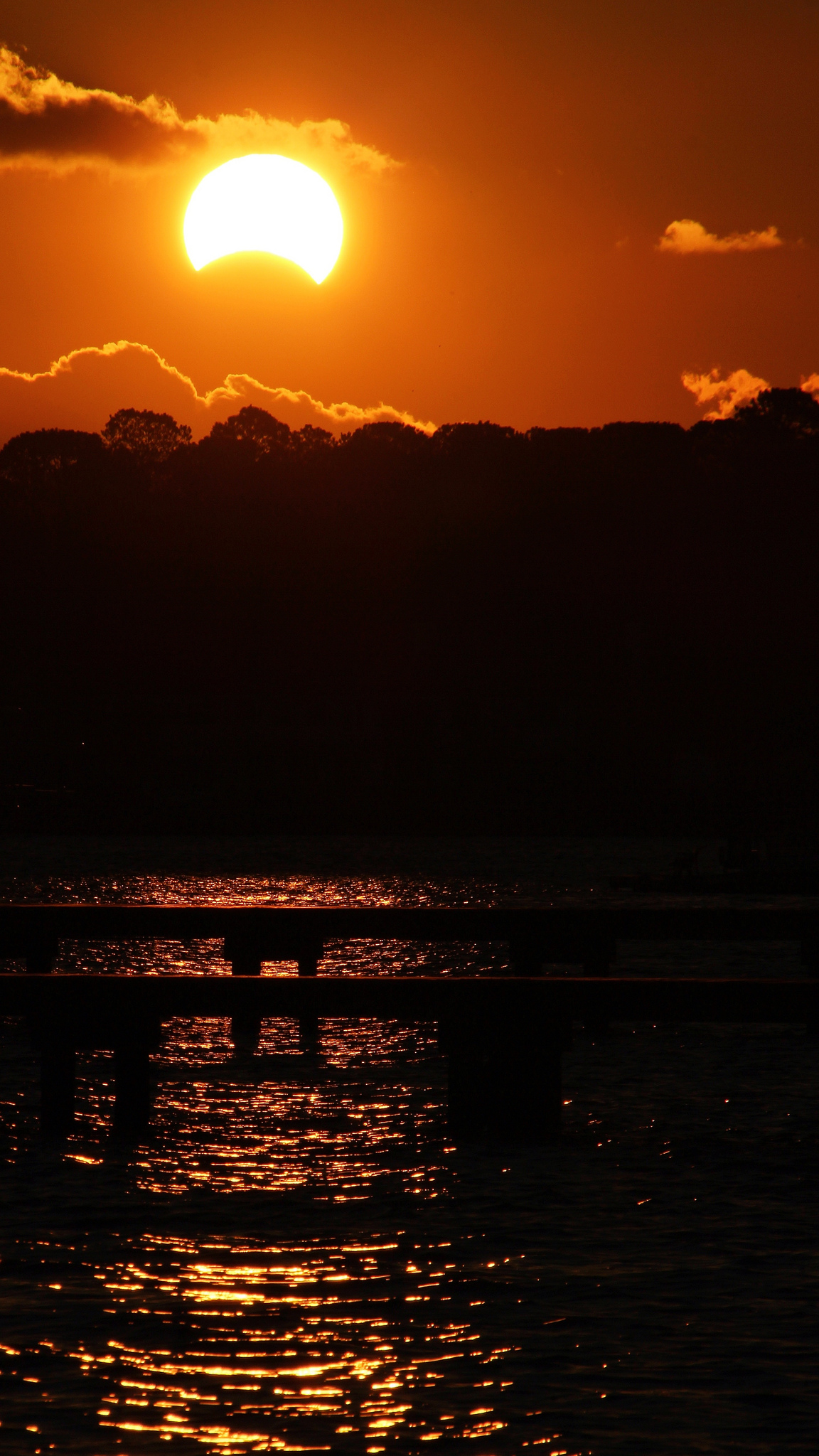
Image

photo credit (creative commons: attribution/no derivs/non-commercial use):http://www.flickr.com/photos/jsmjr/10644426915/

Copyright on TEXT/POETRY © 2013 Su Layug. All Rights Reserved.*

The Moon Bit the Sun
by Su Layug

The moon bit the sun
over the pi-legged docks~
sleep’s bonus hour


Mom in KSA
poses for half-smile selfie~
kingdom eclipses


A night crab scuttles
among eclipse tourists’ bags~
the apocalypse


Child sleeps in dad’s arm
under sun-and-moon mingling~
oceanic sighs


T’was hide-or-be-killed
sun-moon collapse among rocks~
a vet’s remembrance


The moon bit the sun
the earth goes hide-and-seeking~
a ship sails for home


Kinagat ng Buwan ang Araw
ni Su Layug


Kagat ng buwan ang araw
sa ibabaw ng daungang hugis-pi~
isang oras pa’ng pagtulog


Si Nanay sa KSA
pilit-ngiti sa selfie~
nagsaklob ang kaharian


Talangkang nataranta
sa mga bagahe ng turista ng eklips~
apokalipto na


Batang nahihimbing sa braso ni Tatay
sa ilalim ng pagsasanib ng araw at buwan~
dagat-dagat na buntunghininga


Magtago ba o mamatay
sa mga batuhan, sa nagsanib na buwan at araw~
alaala ng isang beterano


Kagat ng buwan ang araw
naglalaro ng taguan ang daigdig~
may naglalayag papauwi

*reblogging/linking as is usual practice, is encouraged and permitted. If you have questions, you’re welcome to email or comment right below the title of the post. Thank you.

Share this:

  • Share on X (Opens in new window) X
  • Share on Pinterest (Opens in new window) Pinterest
  • Share on LinkedIn (Opens in new window) LinkedIn
  • Share on Tumblr (Opens in new window) Tumblr
  • Share on Facebook (Opens in new window) Facebook
  • Email a link to a friend (Opens in new window) Email
  • Share on Reddit (Opens in new window) Reddit
Like Loading...
← Older posts

Pages

  • About
  • Blog Posts

Recent Posts

  • The Red Wheelbarrow by William Carlos Williams (Transcreation to Tagalog by Su Layug)
  • Hango: Tula ng Bagong Taon (Excerpt: New Year’s Poem by Margaret Avison)
  • Translation to Tagalog / Filipino: A Proclamation for Peace by Kim Stafford (translator: Su Layug)
  • Hango: Salamin ng Lumbay (Excerpt: Melancholy’s Mirror by Robert Cording)
  • A Friend of Mine (Aking Kaibigan)

Archives

  • September 2026
  • January 2025
  • July 2024
  • February 2024
  • January 2024
  • November 2023
  • October 2023
  • September 2023
  • May 2023
  • January 2023
  • October 2022
  • September 2022
  • May 2016
  • January 2016
  • February 2015
  • September 2014
  • April 2014
  • March 2014
  • November 2013
  • October 2013
  • September 2013
  • May 2013
  • April 2013
  • March 2013
  • January 2013
  • October 2012
  • June 2012

Categories

  • #Transcreation
  • Autumn
  • Chris Hadfield
  • creative writing
  • EDSA1
  • Filipino
  • flowers
  • garden
  • immigration
  • International Mother Language Day
  • ISS
  • Levertov
  • Marcos Regime
  • Micropoetry
  • Mother Language
  • Naomi Shihab Nye
  • NaPoMo
  • National Poetry Month
  • NPR
  • People Power
  • Philippines
  • poem
  • Poetry Translation
  • Protest
  • summer
  • Tagalog
  • Tagalog
  • TMMpoetry
  • translation
  • Tumblr
  • Twitter
  • Twitter Poetry

Meta

  • Create account
  • Log in
  • Entries feed
  • Comments feed
  • WordPress.com
September 2026
S M T W T F S
 12345
6789101112
13141516171819
20212223242526
27282930  
« Jan    

Archives

  • September 2026
  • January 2025
  • July 2024
  • February 2024
  • January 2024
  • November 2023
  • October 2023
  • September 2023
  • May 2023
  • January 2023
  • October 2022
  • September 2022
  • May 2016
  • January 2016
  • February 2015
  • September 2014
  • April 2014
  • March 2014
  • November 2013
  • October 2013
  • September 2013
  • May 2013
  • April 2013
  • March 2013
  • January 2013
  • October 2012
  • June 2012

su_layug

Tweets by su_layug

Blog at WordPress.com.

Is this your new site? Log in to activate admin features and dismiss this message
Log In
  • Subscribe Subscribed
    • waterjug
    • Join 44 other subscribers
    • Already have a WordPress.com account? Log in now.
    • waterjug
    • Subscribe Subscribed
    • Sign up
    • Log in
    • Report this content
    • View site in Reader
    • Manage subscriptions
    • Collapse this bar
Loading Comments...
%d