• About
  • Blog Posts

waterjug

~ Tagalog (Filipino) Translations of Poetry from English and Vice Versa. Run Out of Love and Passion, Never Out of Words.

waterjug

Tag Archives: birds

The Red Wheelbarrow by William Carlos Williams (Transcreation to Tagalog by Su Layug)

17 Thursday Sep 2026

Posted by Su Layug in #Transcreation, Filipino, Philippines, poem, Poetry Translation, Tagalog, translation

≈ Leave a comment

Tags

birds, faith, Filipino translation, Fillipino, poem, poems, Poetry, psalm, sparrows, Tagalog, Tagalog translation, transcreation, translation, wheelbarrow, William Carlos Williams
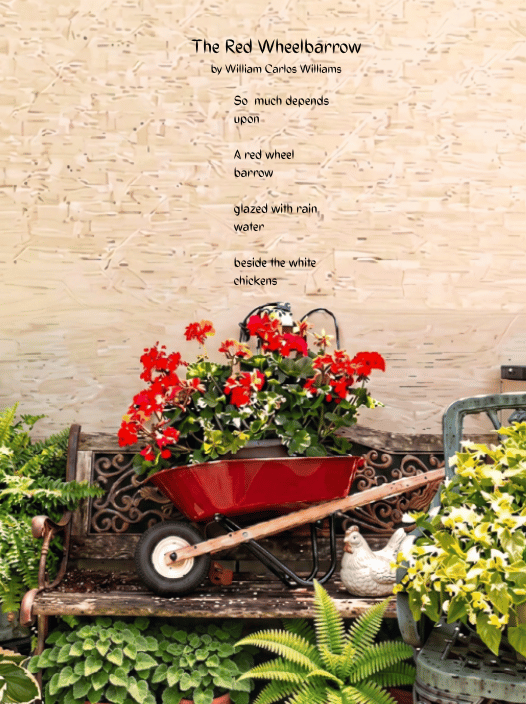
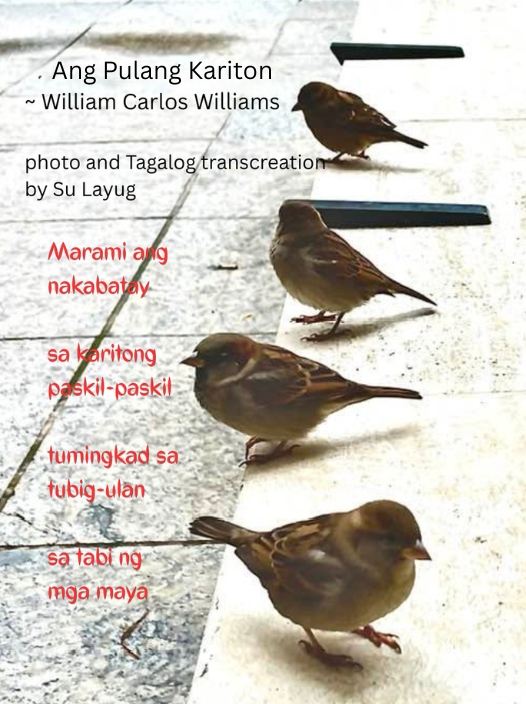
Today, I was delighted to discover that Poetry Foundation posted William Carlos Williams’ “A Red Wheelbarrow.” I’ve always wanted to translate/transcreate this poem. The challenge I had was multifold:

1. I didn’t realize until now that the poem had already been in public domain. Before that, translating it partially would’ve really done nothing since it’s very short.

2. So much depends (haha, yes, the phrase applies) on the transfer of the cadence and brevity of the poem, while, at the same time, delivering a statement to the target audience: my Filipino readers. Imagery alone, in my belief, would not make sense in the transfer of meaning and relevance. There has to be something else. A sort of touching base in that short burst of imagery.

3. It had taken me some (more) level of maturity to dare transcreate rather than merely translate poetry. These days, I look into finding resonance between the mundane and the transcendent. In this poem, I was trying to find the tie between the American ordinary and the Philippine everyday. Maybe these are my years of going back to my roots while struggling to stay anchored to the here and now. In the process, here is what I came up with:

NOTES:

  • A “kariton” is a makeshift pushcart made of pieces of wood, plyboard, metal and sometimes, tarpaulin. It is usually found on the streets of the metropolis, sometimes used for peddling goods, sometimes for collecting junk for repurposing, sometimes for keeping and transporting the personal belongings of a homeless person or family. Whatever can be found to put together a kariton is fair game. As a child, I have seen karitons that were partially made with plyboard used for placards and posters of politicians. As that same young child learning to read, I once got frustrated trying to make sense of a homeless person’s kariton that partially read: “Vote for P_” and below it “for Cong_.” As a young adult I found dark humor in the irony of politicians’ making good on their promise of offering “better lives” through their placard faces becoming truly helpful in the form of kariton.
  • “Paskil-paskil” (patched together) is a choice over “pula” (red) for the reason given above. The kariton would not be normally painted red, as the paint would have been an additional cost.
  • “Maya” (a common sparrow) was chosen over “manok” (chicken) because chickens are not normally found roaming the streets of Metro Manila. If there was one that ever got out of the cage on the way to the market to be sold, that chicken would not last an hour. Someone would’ve already caught that bird to cook as tinola for supper.
  • “Maya” as a reference to the common sparrow is an allusion to the Christian faith of Filipinos. Even as the kariton is a testament to resilience and adaptation to the sparseness of material things, the sparrow is a biblical reference to Psalm 84:3, which says, “Even the sparrow has found a home, and the swallow a nest for herself, where she may have her young—a place near your altar, Lord Almighty, my King and my God.” I am not a religious person, but many Filipinos are, and this transcreation is a commentary on that faith and hopefulness of the Filipino people. So much, indeed, depends upon the red wheelbarrow.

Use of AI disclosure: The wheelbarrow photo was an original photo by the author, partially AI-edited with Canva (app) to render suitable for juxtaposing the poem. The sparrow photo is an original photo by the author, NO AI WAS USED in the sparrows photo nor in the translation/transcreation of the poem.
Share this:

  • Share on X (Opens in new window) X
  • Share on Pinterest (Opens in new window) Pinterest
  • Share on LinkedIn (Opens in new window) LinkedIn
  • Share on Tumblr (Opens in new window) Tumblr
  • Share on Facebook (Opens in new window) Facebook
  • Email a link to a friend (Opens in new window) Email
  • Share on Reddit (Opens in new window) Reddit
Like Loading...

Hango: Tula ng Bagong Taon (Excerpt: New Year’s Poem by Margaret Avison)

03 Friday Jan 2025

Posted by Su Layug in Poetry Translation

≈ 4 Comments

Tags

2025, birds, cosmic wisdom, death, Filipino, Filipino translation, flourishing, grieving, lark, life, Margaret Avison, mindfulness, new year, Poetry, recovery, renewal, snow, starling, swallows, Tagalog, Tagalog translation, translation, Winter

Translated to Tagalog / Filipino by Su Layug


          Naaalala ko
Ang bigat-balaning halimuyak ni Anne, ang di-matinag na puntod
Na mumunti lamang ang nakukupkop ng lamig;
Magiliw kong binabakas ang mga bungo at brasong buto
Mga anyong kinahig ng mga kulansiyang at langay-langayan, sa pagkuha nila ng rabaw,
At ang mahabang silo ng amihan
Nililinaw ang pagkurba ng arko nito, mula sa bituing Arcturus
Hanggang sa laryong kanto ng patyo,
At sa pasimanong walang-galaw.
Malumanay at makatarungang kasiyahan
bilang nilalang ang makamit mula sa kalawakan
Itong maligamgam at napagnanahanang kalooban
Na tahimik na sumasalamin sa sinag
ng (harayang) niyebe, at ng bagong taon.
             I remember   
Anne’s rose-sweet gravity, and the stiff grave
Where cold so little can contain;
I mark the queer delightful skull and crossbones
Starlings and sparrows left, taking the crust,
And the long loop of winter wind
Smoothing its arc from dark Arcturus down
To the bricked corner of the drifted courtyard,
And the still window-ledge.
Gentle and just pleasure
It is, being human, to have won from space
This unchill, habitable interior
Which mirrors quietly the light
Of the snow, and the new year.

Translator’s notes:

One of the challenges of translating from a language of one climate zone to another of a different climate zone is the concept of the seasons. The original English was clearly written in the context of the temperate zone of the northern hemisphere where snow commonly exists at the turning of the year, whereas Filipino / Tagalog is a language from a tropical climate. Two considerations:

1) the migration of birds, which is, to me, a central concept in the passing of time and the subtle shifting of sentiments, whether natural or induced, is seen by this translator as crucial in the portayal of emotional flourishing–and survival. The lark is perceived as the common-and-yet heroic bird, rising at the dawn of day, a natural bringer of joy with its songs, cited in many poetic lines, such as Shakespeare’s Sonnet 29. The starling, in contrast, is the less-than-heroic one which tends to be destructive to fruits and other vegetation, and yet is remarkable in its mimicry of other birds and sounds, as though such pretense is crucial for existence, even survival.

The translation, to Filipino, however, does not equate to the actual names of the birds. Though also migratory, the Philippine starling (kulansiyang) remains the less-than-heroic one, with its noise-making as its most recognizable feature, though not the mimicry of the northern hemisphere starling. The langay-langayan, which is the equivalent of the swallow (and not the lark), is the more graceful, poetic bird in this translation. It is usually associated with grace, hope, and renewal.

2) In translating “snow” I have opted to include the notion that “niyebe” (Spanish-derived word for “snow”) may be imagined as signified by the parenthesized word “haraya” (imagined). With this duality, the context then shifts back-and-forth from the experience of a Filipino who may have never left the Philippines, but is intellectually familiar with snow, to that of a Filipino who has migrated to a country where snow is a real experience. In either case, the experience of snow as part of the awakening, and/or survival/recovery/grieving/flourishing/renewal process, in its complexity, is real, whether to a migratory or a colonized mind, or both

The full English poem can be read here: https://www.poetryfoundation.org/poems/51733/new-years-poem?utm_source=Poetry%20Foundation&utm_campaign=bc1922be67-NO_TITLE&utm_medium=email&utm_term=0_ff7136981c-bc1922be67-185698833&mc_cid=bc1922be67&mc_eid=3b56d6ba23

Share this:

  • Share on X (Opens in new window) X
  • Share on Pinterest (Opens in new window) Pinterest
  • Share on LinkedIn (Opens in new window) LinkedIn
  • Share on Tumblr (Opens in new window) Tumblr
  • Share on Facebook (Opens in new window) Facebook
  • Email a link to a friend (Opens in new window) Email
  • Share on Reddit (Opens in new window) Reddit
Like Loading...

Pages

  • About
  • Blog Posts

Recent Posts

  • The Red Wheelbarrow by William Carlos Williams (Transcreation to Tagalog by Su Layug)
  • Hango: Tula ng Bagong Taon (Excerpt: New Year’s Poem by Margaret Avison)
  • Translation to Tagalog / Filipino: A Proclamation for Peace by Kim Stafford (translator: Su Layug)
  • Hango: Salamin ng Lumbay (Excerpt: Melancholy’s Mirror by Robert Cording)
  • A Friend of Mine (Aking Kaibigan)

Archives

  • September 2026
  • January 2025
  • July 2024
  • February 2024
  • January 2024
  • November 2023
  • October 2023
  • September 2023
  • May 2023
  • January 2023
  • October 2022
  • September 2022
  • May 2016
  • January 2016
  • February 2015
  • September 2014
  • April 2014
  • March 2014
  • November 2013
  • October 2013
  • September 2013
  • May 2013
  • April 2013
  • March 2013
  • January 2013
  • October 2012
  • June 2012

Categories

  • #Transcreation
  • Autumn
  • Chris Hadfield
  • creative writing
  • EDSA1
  • Filipino
  • flowers
  • garden
  • immigration
  • International Mother Language Day
  • ISS
  • Levertov
  • Marcos Regime
  • Micropoetry
  • Mother Language
  • Naomi Shihab Nye
  • NaPoMo
  • National Poetry Month
  • NPR
  • People Power
  • Philippines
  • poem
  • Poetry Translation
  • Protest
  • summer
  • Tagalog
  • Tagalog
  • TMMpoetry
  • translation
  • Tumblr
  • Twitter
  • Twitter Poetry

Meta

  • Create account
  • Log in
  • Entries feed
  • Comments feed
  • WordPress.com
September 2026
S M T W T F S
 12345
6789101112
13141516171819
20212223242526
27282930  
« Jan    

Archives

  • September 2026
  • January 2025
  • July 2024
  • February 2024
  • January 2024
  • November 2023
  • October 2023
  • September 2023
  • May 2023
  • January 2023
  • October 2022
  • September 2022
  • May 2016
  • January 2016
  • February 2015
  • September 2014
  • April 2014
  • March 2014
  • November 2013
  • October 2013
  • September 2013
  • May 2013
  • April 2013
  • March 2013
  • January 2013
  • October 2012
  • June 2012

su_layug

Tweets by su_layug

Blog at WordPress.com.

Is this your new site? Log in to activate admin features and dismiss this message
Log In
  • Subscribe Subscribed
    • waterjug
    • Join 44 other subscribers
    • Already have a WordPress.com account? Log in now.
    • waterjug
    • Subscribe Subscribed
    • Sign up
    • Log in
    • Report this content
    • View site in Reader
    • Manage subscriptions
    • Collapse this bar
Loading Comments...
%d