• About
  • Blog Posts

waterjug

~ Tagalog (Filipino) Translations of Poetry from English and Vice Versa. Run Out of Love and Passion, Never Out of Words.

waterjug

Tag Archives: death

Hango: Tula ng Bagong Taon (Excerpt: New Year’s Poem by Margaret Avison)

03 Friday Jan 2025

Posted by Su Layug in Poetry Translation

≈ 4 Comments

Tags

2025, birds, cosmic wisdom, death, Filipino, Filipino translation, flourishing, grieving, lark, life, Margaret Avison, mindfulness, new year, Poetry, recovery, renewal, snow, starling, swallows, Tagalog, Tagalog translation, translation, Winter

Translated to Tagalog / Filipino by Su Layug


          Naaalala ko
Ang bigat-balaning halimuyak ni Anne, ang di-matinag na puntod
Na mumunti lamang ang nakukupkop ng lamig;
Magiliw kong binabakas ang mga bungo at brasong buto
Mga anyong kinahig ng mga kulansiyang at langay-langayan, sa pagkuha nila ng rabaw,
At ang mahabang silo ng amihan
Nililinaw ang pagkurba ng arko nito, mula sa bituing Arcturus
Hanggang sa laryong kanto ng patyo,
At sa pasimanong walang-galaw.
Malumanay at makatarungang kasiyahan
bilang nilalang ang makamit mula sa kalawakan
Itong maligamgam at napagnanahanang kalooban
Na tahimik na sumasalamin sa sinag
ng (harayang) niyebe, at ng bagong taon.
             I remember   
Anne’s rose-sweet gravity, and the stiff grave
Where cold so little can contain;
I mark the queer delightful skull and crossbones
Starlings and sparrows left, taking the crust,
And the long loop of winter wind
Smoothing its arc from dark Arcturus down
To the bricked corner of the drifted courtyard,
And the still window-ledge.
Gentle and just pleasure
It is, being human, to have won from space
This unchill, habitable interior
Which mirrors quietly the light
Of the snow, and the new year.

Translator’s notes:

One of the challenges of translating from a language of one climate zone to another of a different climate zone is the concept of the seasons. The original English was clearly written in the context of the temperate zone of the northern hemisphere where snow commonly exists at the turning of the year, whereas Filipino / Tagalog is a language from a tropical climate. Two considerations:

1) the migration of birds, which is, to me, a central concept in the passing of time and the subtle shifting of sentiments, whether natural or induced, is seen by this translator as crucial in the portayal of emotional flourishing–and survival. The lark is perceived as the common-and-yet heroic bird, rising at the dawn of day, a natural bringer of joy with its songs, cited in many poetic lines, such as Shakespeare’s Sonnet 29. The starling, in contrast, is the less-than-heroic one which tends to be destructive to fruits and other vegetation, and yet is remarkable in its mimicry of other birds and sounds, as though such pretense is crucial for existence, even survival.

The translation, to Filipino, however, does not equate to the actual names of the birds. Though also migratory, the Philippine starling (kulansiyang) remains the less-than-heroic one, with its noise-making as its most recognizable feature, though not the mimicry of the northern hemisphere starling. The langay-langayan, which is the equivalent of the swallow (and not the lark), is the more graceful, poetic bird in this translation. It is usually associated with grace, hope, and renewal.

2) In translating “snow” I have opted to include the notion that “niyebe” (Spanish-derived word for “snow”) may be imagined as signified by the parenthesized word “haraya” (imagined). With this duality, the context then shifts back-and-forth from the experience of a Filipino who may have never left the Philippines, but is intellectually familiar with snow, to that of a Filipino who has migrated to a country where snow is a real experience. In either case, the experience of snow as part of the awakening, and/or survival/recovery/grieving/flourishing/renewal process, in its complexity, is real, whether to a migratory or a colonized mind, or both

The full English poem can be read here: https://www.poetryfoundation.org/poems/51733/new-years-poem?utm_source=Poetry%20Foundation&utm_campaign=bc1922be67-NO_TITLE&utm_medium=email&utm_term=0_ff7136981c-bc1922be67-185698833&mc_cid=bc1922be67&mc_eid=3b56d6ba23
Share this:

  • Share on X (Opens in new window) X
  • Share on Pinterest (Opens in new window) Pinterest
  • Share on LinkedIn (Opens in new window) LinkedIn
  • Share on Tumblr (Opens in new window) Tumblr
  • Share on Facebook (Opens in new window) Facebook
  • Email a link to a friend (Opens in new window) Email
  • Share on Reddit (Opens in new window) Reddit
Like Loading...

Hango: Salamin ng Lumbay (Excerpt: Melancholy’s Mirror by Robert Cording)

11 Sunday Feb 2024

Posted by Su Layug in Poetry Translation

≈ Leave a comment

Tags

death, Filipino, Filipino translation, grief, literary translation, melancholy, Poetry, Robert Cording, Tagalog, Tagalog translation, translation

A Translation from English to Filipino by Su Layug

Kabilang ako ngayon sa sarili kong anatomiya ng lumbay—

Sa tagal nitong paghihintay sa hindi mangyari-yari

Sa pagtrangka nito sa kinabukasan. Sa pagkaalam nito

sa lagpas-kamatayan na hanggang doon na lang

ang alam. Ang pagkainutil nitong kumpletuhin

ang buhay na basta na lamang nagwakas. Imahe ni Durer,

may pakpak ngunit paralisado, napupung-aw, nakalatag

ang mga kagamitan sa harap niya, ngunit hindi makalikha. Ang mga salitang ito

na wari’y mga insektong nagkukubli ngayong dapithapong taglamig.
I belong today to my own anatomy of melancholy—

its long wait for what never happens.
Its shut down of the future. Its after-
knowledge of death that knows no more
than it did before. Its inability to complete
a life that simply ended. Dürer's figure,
winged but paralyzed, moping, tools spread
before him, but unable to create. These words
that lurk like insects this winter late afternoon.

Translator’s Notes:

1 “Hindi mangyari-yari” — the repetition of the root word, “yari” (to happen) at the end denotes the (non-) fruition of the action verb “happen.” (“that never happens”). An alternative is to say “hindi mangyayari” (will never happen) but the earlier phrase, “hindi mangyari-yari” suggests a recurring wish for something to happen, and the recurring end-result of that something never happening.

2. What I found especially difficult to translate are the lines, “Its after-/ knowledge of death that knows no more / than it did before.” The question arises: what does “that” refer to?” Does it refer to “melancholy,” to which the persona belongs to, and thus represents them? Or does it refer to “after-knowledge” (that knows no more than it did before)? I took the liberty of interpreting “that” as referring to “melancholy” which existed before and after the death being talked about. Thus, the Filipino translation, “sa kaalaman sa lampas-kamatayan” (the knowledge of (what is) beyond death) “na hanggang doon na lang ang alam” (which is its (melancholy’s) limit of knowing)

3. Through Cording’s article (a personal essay, its link below), which I found online after writing this translation, we can confirm that this poem is an autobiographical one — that, indeed, it refers to the death of Cording’s son. The poem refers to the visual artist Albrecht Dürer‘s work Melencolia (1513/1514) in the last stanza. The grief of the persona due to the death of his son is juxtaposed with his grief of not being able to create, juxtaposed with the realization that his son, himself, will no longer be able to create, his life having been taken too soon.

4. I chose to say, “Filipino translation,” rather than “Tagalog translation” because I chose to use the word, “napupung-aw” (moping, being melancholic) which is not Tagalog, but Bicolano — the native language of my late mother. I wish I learned her language more.

This is the link to the whole poem in English: https://poems.com/poem/melancholys-mirror/
This is the link to Robert Cording’s personal essay, In the Unwalled City: https://imagejournal.org/article/in-the-unwalled-city/

Share this:

  • Share on X (Opens in new window) X
  • Share on Pinterest (Opens in new window) Pinterest
  • Share on LinkedIn (Opens in new window) LinkedIn
  • Share on Tumblr (Opens in new window) Tumblr
  • Share on Facebook (Opens in new window) Facebook
  • Email a link to a friend (Opens in new window) Email
  • Share on Reddit (Opens in new window) Reddit
Like Loading...

Filipino translation: “Water Lantern Festival”

06 Wednesday Sep 2023

Posted by Su Layug in creative writing, Filipino, Poetry Translation

≈ Leave a comment

Tags

Autumn, death, Filipino translation, Love, Poetry, Tagalog translation

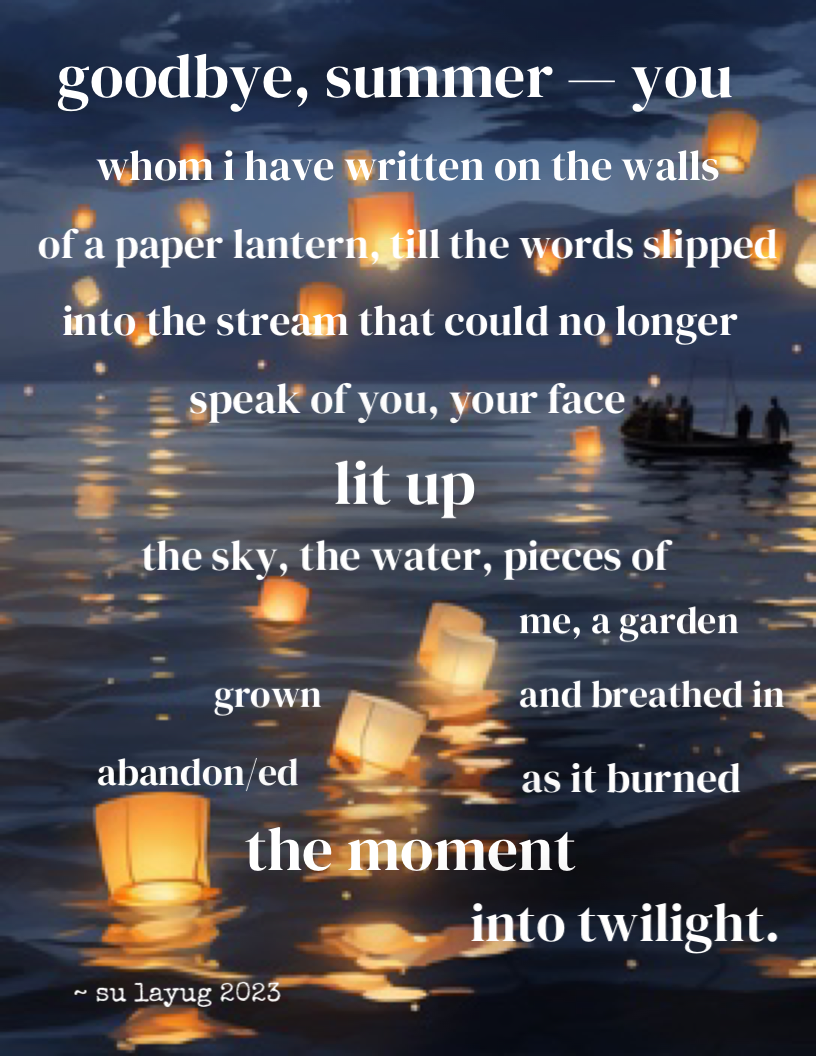
Human poetry overlaid on AI-generated visual (Midjourney)

Pista ng Mga Lampara sa Tubig

Paalam, Tag-init – ikaw
na isinulat ko sa mga dingding
ng lamparang papel, hanggang pumanaog ang mga salita
sa daloy na hindi na/kayang
bigkasin ang ngalan mo, ang iyong mukha/ng --
suminag sa langit at tubig. mga piraso
ng pagkatao ko – isang hardin
na lumago at huminga/inihinga
nang walang pag-aalala o alinlangan/iniwan
habang pinaliliyab ang sandaling
padapithapon.

translated to Tagalog/Filipino by Su Layug

Share this:

  • Share on X (Opens in new window) X
  • Share on Pinterest (Opens in new window) Pinterest
  • Share on LinkedIn (Opens in new window) LinkedIn
  • Share on Tumblr (Opens in new window) Tumblr
  • Share on Facebook (Opens in new window) Facebook
  • Email a link to a friend (Opens in new window) Email
  • Share on Reddit (Opens in new window) Reddit
Like Loading...

Notes from Leyte (found poem from the news)

11 Monday Nov 2013

Posted by Su Layug in Filipino, poem, Poetry Translation, Tagalog

≈ Leave a comment

Tags

death, Filipino, Filipino translation, Haiyan, letters, life, notes, Philippines, poem, Poetry, storm, super typhoon, superstorm, Tagalog translation, typhoon, Yolanda, YolandaPH

Image
photo: flickr/Patrick Hoesly


Copyright on TEXT/POETRY © 2013 Su Layug. All Rights Reserved.*

Notes from Leyte

(found poem from the news) http://www.gmanetwork.com/news/story/334829/news/nation/buhi-kami-tanan-yolanda-survivors-send-messages-to-loved-ones

On the rippled edge
of a half-moon paper plate —
perhaps kept dry in a bag
for a wedge of a birthday cake —
the scribbling says,
“Buhi Kami Tanan.”
(We’re All Alive)

On a narrow-ruled page,
ripped from a spiral
that used to bind school notes,
in curly manuscript:
“We’re fine. No house, no food.
Nothing.
Still looking
for Big Diding.
Don’t worry.”

A piece of brown bag,
kept neat, perhaps, to wrap
kan-on, sinugba or a sandwich
that mother or father would have made:
in bold, block letters, says,
“Ate, mom and dad are dead. Please
tell everyone.
No connection.”

I wish the world to write them back:

Mga Sulat Mula sa Leyte

(natuklasang tula, mula sa balita)

Sa alun-along gilid ng hating-buwan
na papel na pinggan —
na maaaring itinabi
para sa isang hiwa ng birthday cake —
nakasulat ito:
“Buhi Kami Tanan.”
(Buhay Kaming Lahat)

Sa makikitid na linya ng isang pahina
na pinunit mula sa alambre
na dati’y nagkukupkop ng mga tala
sa eskwela,
sa mapalabok na panulat:
“Ligtas kami. Walang bahay, walang pagkain.
Waray.
Hinahanap pa rin
si Diding Laki.
Ayaw la kabalaka.”

Sa pirasong paper bag
na masinop ang tiklop, siguro’y pagbabalutan
Ng kan-on, sugba o sandwich
na gagawin sana ni nanay o tatay:
Sa malalaki’t makakapal na letra,
“Ate, patay na si mommy at daddy. Pakisabi
sa lahat.
Walang koneksiyon.”

Pagnanasa ko ang balik-sulat ng mundo:

Share this:

  • Share on X (Opens in new window) X
  • Share on Pinterest (Opens in new window) Pinterest
  • Share on LinkedIn (Opens in new window) LinkedIn
  • Share on Tumblr (Opens in new window) Tumblr
  • Share on Facebook (Opens in new window) Facebook
  • Email a link to a friend (Opens in new window) Email
  • Share on Reddit (Opens in new window) Reddit
Like Loading...

Why I love the Dead Red Leaf by Su Layug (a prose-poem translated to Filipino)

02 Saturday Nov 2013

Posted by Su Layug in Poetry Translation

≈ Leave a comment

Tags

arugula, aspen, Autumn, death, English to Filipino, English to Tagalog, Filipino prose poem, Filipino translation, leaves, life, red oak leaf, seasons, Tagalog prose poem

Image

Copyright © 2013 Su Layug. All Rights Reserved.*

Kung Bakit Gusto Ko ang Patay na Dahong Pula (pagsasalin ng hango) ~ ni Su Layug

Ang Aspen, gamit ang pulido nitong tangkay,  ay ang prima donna ng sayaw na ito. Kahit na bago pa dumating ang pagwawalis ng bagyo, itinatago nito ang kaniyang mukha, tumatalikod upang ihantad ang pinilakang gulugod, na wari’y nagsasabi kay Kamatayan: wala akong nalalabing maibibigay sa iyo,.  Simutin mo man ang buhay kong maputla, kakapit at kakapit pa rin ako bilang kalansay sa aking Puno, sa aking Tadhana.  Sa kalaunang pagkahulog, minumulto ng Aspen ang mga yapakan ng kagubatan. Hindi lang ito basta nakatingala mula sa lupa. Makanti lamang ng hangin, umiiling ito na parang nagsasabi: “Hindi, hindi, hindi!” Wari’y hindi nito matanto o matanggap ang pagkawalang-saysay ng kaniyang tunggali. Ang Don Quixote ng kaharian ng mga dahon, sinasabak ng dahon ng Aspen ang apat na patalim ng windmill ng pagpapalit ng panahon. Ang dahon ng Aspen ay isang kaluluwang pampurgatoryo.

Why I Love the Dead Red Leaf (excerpt) ~ by Su Layug

The Aspen, with its dexterous petiole is the prima donna of this dance. Even before the purge by thunderstorms, it hides its face, shows its silvery back, as though to say to Death: I have nothing left for you to take. Scrape me of my pallid life, I will still cling as skeleton to my Tree, my Destiny. The Aspen leaf, eventually fallen, haunts the forest footpaths. It doesn’t just lie there. At the slightest touch of wind, its body quivers so, “No, no, no!” It doesn’t seem to realize nor accept the futility of its struggle. The Don Quixote of the foliage kingdom,the Aspen leaf fights the four-bladed windmill that is the turning of the season. The Aspen leaf is a purgatory soul.

The whole prose-poem can be read here: https://medium.com/no-category-for-this/bad76a37eb71

*reblogging/linking, as usual practice, is encouraged and permitted. If you have questions, you’re welcome to email or comment right below the title of the post. Thank you.

Share this:

  • Share on X (Opens in new window) X
  • Share on Pinterest (Opens in new window) Pinterest
  • Share on LinkedIn (Opens in new window) LinkedIn
  • Share on Tumblr (Opens in new window) Tumblr
  • Share on Facebook (Opens in new window) Facebook
  • Email a link to a friend (Opens in new window) Email
  • Share on Reddit (Opens in new window) Reddit
Like Loading...

Tula ng Agila (Eagle Poem) by Joy Harjo, translated to Filipino by Su Layug

27 Saturday Apr 2013

Posted by Su Layug in Poetry Translation

≈ Leave a comment

Tags

birth, blessedness, connectivity, death, eagle, Filipino translation, Joy Harjo, life cycle, nature, poem, Poetry, prayer, sacred, stewardship, Tagalog translation

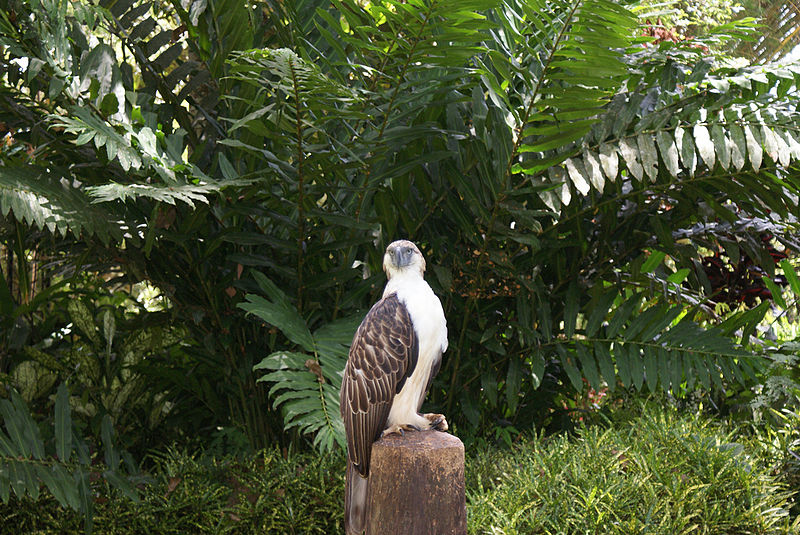
800px-Philippine_Eagle_in_Captivity

The Philippine Eagle in captivity, photo courtesy of scorpious18 on flickr via wikimedia.org under creative commons license

Sa pagsamba, binubuksan mo ang buong sarili
Sa langit, sa lupa, sa araw, sa buwan
Sa kabuuuan ng tinig na ikaw.
At batid pa rin na mayroon pang
Hindi mo nakikita, naririnig;
Hindi mo mababatid maliban sa mga sandaling
Lumalago, at sa mga wikang
Maaaring hindi tunog, kundi ibang
Ikot ng galaw.
Gaya ng agila nitong Linggong umaga
Sa Ilog ng Asin. Umikot sa langit na bughaw
Sa hangin, winalis-linis ang ating mga puso
ng kanyang mga sagradong pakpak.
Nakikita ka namin, nakikita namin ang sarili at nababatid naming
Kailangang pangalagaan nang puspusan
At pagbaitan ang lahat ng bagay.
Huminga nang malalim, sa kaalamang tayo ay binubuo ng
Lahat ng ito, at huminga, sa kaalamang
Tayo ay tunay na pinagpala sapagkat tayo’y
Ipinanganak, at tayo’y lilisan din sa loob ng
Tunay na pag-ikot,
Gaya ng agilang nililibot ang umaga
Ng ating kalooban.
Pinapanalangin natin na maisagawa ito
Sa kagandahan,
Sa kagandahan.

Original poem in English can be read here: http://www.poetryfoundation.org/poem/175881

Creative Commons License
This work is licensed under a Creative Commons Attribution-NonCommercial-NoDerivs 3.0 Unported License.

Share this:

  • Share on X (Opens in new window) X
  • Share on Pinterest (Opens in new window) Pinterest
  • Share on LinkedIn (Opens in new window) LinkedIn
  • Share on Tumblr (Opens in new window) Tumblr
  • Share on Facebook (Opens in new window) Facebook
  • Email a link to a friend (Opens in new window) Email
  • Share on Reddit (Opens in new window) Reddit
Like Loading...

Pages

  • About
  • Blog Posts

Recent Posts

  • The Red Wheelbarrow by William Carlos Williams (Transcreation to Tagalog by Su Layug)
  • Hango: Tula ng Bagong Taon (Excerpt: New Year’s Poem by Margaret Avison)
  • Translation to Tagalog / Filipino: A Proclamation for Peace by Kim Stafford (translator: Su Layug)
  • Hango: Salamin ng Lumbay (Excerpt: Melancholy’s Mirror by Robert Cording)
  • A Friend of Mine (Aking Kaibigan)

Archives

  • September 2026
  • January 2025
  • July 2024
  • February 2024
  • January 2024
  • November 2023
  • October 2023
  • September 2023
  • May 2023
  • January 2023
  • October 2022
  • September 2022
  • May 2016
  • January 2016
  • February 2015
  • September 2014
  • April 2014
  • March 2014
  • November 2013
  • October 2013
  • September 2013
  • May 2013
  • April 2013
  • March 2013
  • January 2013
  • October 2012
  • June 2012

Categories

  • #Transcreation
  • Autumn
  • Chris Hadfield
  • creative writing
  • EDSA1
  • Filipino
  • flowers
  • garden
  • immigration
  • International Mother Language Day
  • ISS
  • Levertov
  • Marcos Regime
  • Micropoetry
  • Mother Language
  • Naomi Shihab Nye
  • NaPoMo
  • National Poetry Month
  • NPR
  • People Power
  • Philippines
  • poem
  • Poetry Translation
  • Protest
  • summer
  • Tagalog
  • Tagalog
  • TMMpoetry
  • translation
  • Tumblr
  • Twitter
  • Twitter Poetry

Meta

  • Create account
  • Log in
  • Entries feed
  • Comments feed
  • WordPress.com
September 2026
S M T W T F S
 12345
6789101112
13141516171819
20212223242526
27282930  
« Jan    

Archives

  • September 2026
  • January 2025
  • July 2024
  • February 2024
  • January 2024
  • November 2023
  • October 2023
  • September 2023
  • May 2023
  • January 2023
  • October 2022
  • September 2022
  • May 2016
  • January 2016
  • February 2015
  • September 2014
  • April 2014
  • March 2014
  • November 2013
  • October 2013
  • September 2013
  • May 2013
  • April 2013
  • March 2013
  • January 2013
  • October 2012
  • June 2012

su_layug

Tweets by su_layug

Blog at WordPress.com.

Is this your new site? Log in to activate admin features and dismiss this message
Log In
  • Subscribe Subscribed
    • waterjug
    • Join 44 other subscribers
    • Already have a WordPress.com account? Log in now.
    • waterjug
    • Subscribe Subscribed
    • Sign up
    • Log in
    • Report this content
    • View site in Reader
    • Manage subscriptions
    • Collapse this bar
Loading Comments...
%d