
Tags
birds, faith, Filipino translation, Fillipino, poem, poems, Poetry, psalm, sparrows, Tagalog, Tagalog translation, transcreation, translation, wheelbarrow, William Carlos Williams
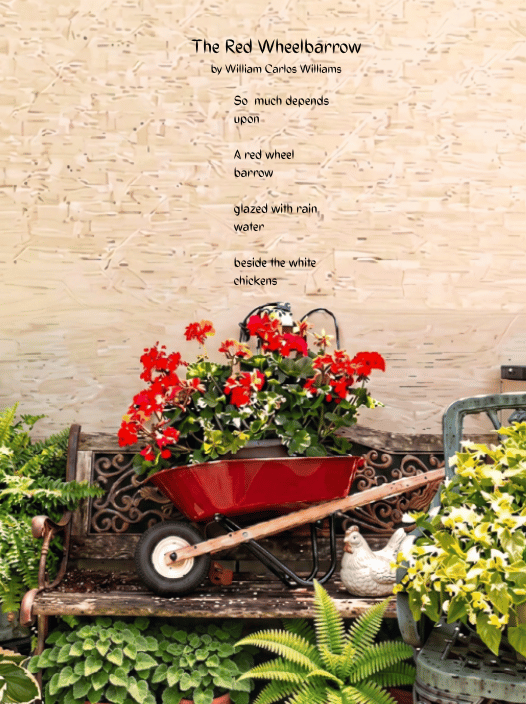
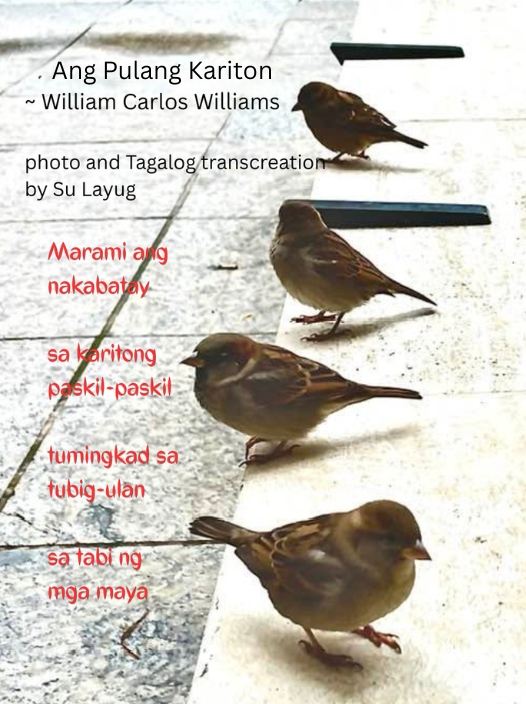
Today, I was delighted to discover that Poetry Foundation posted William Carlos Williams’ “A Red Wheelbarrow.” I’ve always wanted to translate/transcreate this poem. The challenge I had was multifold:
1. I didn’t realize until now that the poem had already been in public domain. Before that, translating it partially would’ve really done nothing since it’s very short.
2. So much depends (haha, yes, the phrase applies) on the transfer of the cadence and brevity of the poem, while, at the same time, delivering a statement to the target audience: my Filipino readers. Imagery alone, in my belief, would not make sense in the transfer of meaning and relevance. There has to be something else. A sort of touching base in that short burst of imagery.
3. It had taken me some (more) level of maturity to dare transcreate rather than merely translate poetry. These days, I look into finding resonance between the mundane and the transcendent. In this poem, I was trying to find the tie between the American ordinary and the Philippine everyday. Maybe these are my years of going back to my roots while struggling to stay anchored to the here and now. In the process, here is what I came up with:
NOTES:
- A “kariton” is a makeshift pushcart made of pieces of wood, plyboard, metal and sometimes, tarpaulin. It is usually found on the streets of the metropolis, sometimes used for peddling goods, sometimes for collecting junk for repurposing, sometimes for keeping and transporting the personal belongings of a homeless person or family. Whatever can be found to put together a kariton is fair game. As a child, I have seen karitons that were partially made with plyboard used for placards and posters of politicians. As that same young child learning to read, I once got frustrated trying to make sense of a homeless person’s kariton that partially read: “Vote for P_” and below it “for Cong_.” As a young adult I found dark humor in the irony of politicians’ making good on their promise of offering “better lives” through their placard faces becoming truly helpful in the form of kariton.
- “Paskil-paskil” (patched together) is a choice over “pula” (red) for the reason given above. The kariton would not be normally painted red, as the paint would have been an additional cost.
- “Maya” (a common sparrow) was chosen over “manok” (chicken) because chickens are not normally found roaming the streets of Metro Manila. If there was one that ever got out of the cage on the way to the market to be sold, that chicken would not last an hour. Someone would’ve already caught that bird to cook as tinola for supper.
- “Maya” as a reference to the common sparrow is an allusion to the Christian faith of Filipinos. Even as the kariton is a testament to resilience and adaptation to the sparseness of material things, the sparrow is a biblical reference to Psalm 84:3, which says, “Even the sparrow has found a home, and the swallow a nest for herself, where she may have her young—a place near your altar, Lord Almighty, my King and my God.” I am not a religious person, but many Filipinos are, and this transcreation is a commentary on that faith and hopefulness of the Filipino people. So much, indeed, depends upon the red wheelbarrow.
Use of AI disclosure: The wheelbarrow photo was an original photo by the author, partially AI-edited with Canva (app) to render suitable for juxtaposing the poem. The sparrow photo is an original photo by the author, NO AI WAS USED in the sparrows photo nor in the translation/transcreation of the poem.



 waterjug