
(excerpt) Poetry Translation
BY LYN HEJINIAN
The leaves outside the window
tricked the eye, demanding that one see them, focus on them,
making it impossible to look past them, and though holes
were opened through the foliage, they were as useless as port-
holes underwater looking into a dark sea, which only reflects
the room one seeks to look out from. Sometimes into
benevolent and other times into ghastly shapes.
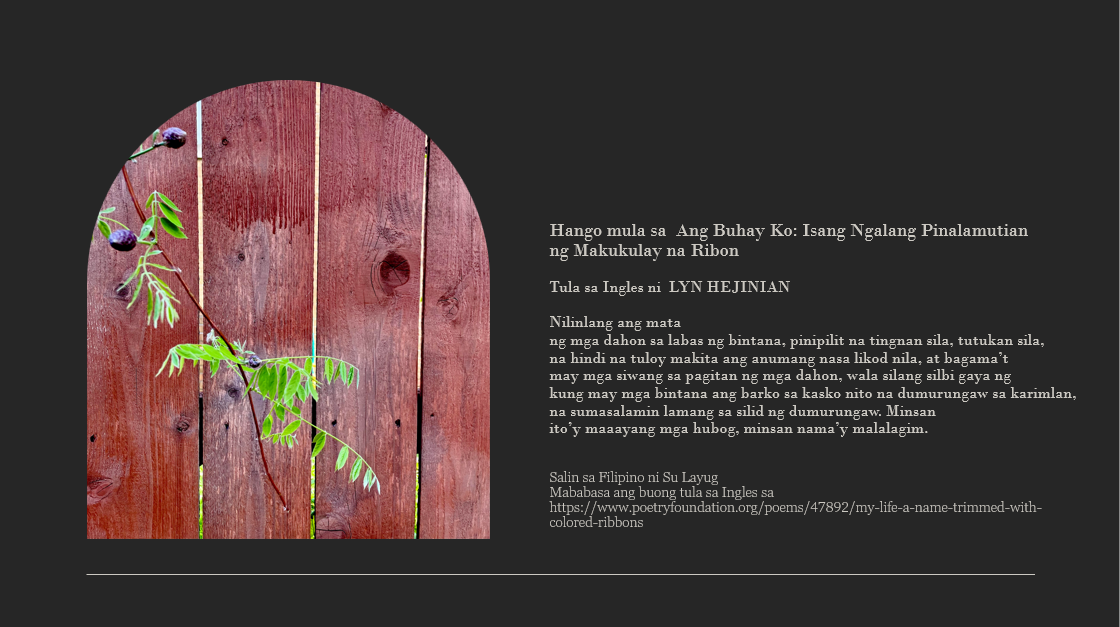
The full text in English can be found at Poetry Foundation: https://www.poetryfoundation.org/poems/47892/my-life-a-name-trimmed-with-colored-ribbons
Translator’s notes:
- To understand how the porthole is “useless” in this context, one needs to realize that portholes of a ship are never found on the part of the ship that is underwater, but above the waterline. A porthole by definition is an opening, a window that lets light and/or air in. It is useless underwater. At first, I thought that maybe the poet was mistaken to have likened the holes in the foliage to portholes below the waterline (there are no portholes below the waterline.) But upon the 2nd or the 3rd reading, it becomes clear that the poet is likening the holes among the foliage to portholes precisely because such openings would be useless, should they be constructed on that part of the ship that is submerged. Thanks to my gigs interpreting tor the US courts in cases that involve maritime laws (albeit, few and far-between), they have given me the insight for rendering this excerpt’s meaning.
- I wanted to use the equivalent of “porthole” in Tagalog/Filipino, if there is an exact equivalent. Searching the usual dictionaries online did not give me a jargon, thus I resorted to using two AI chat portals. Google Bard came up with “bintana ng barko” which translates to “window of a ship.” Microsoft Bing came up with a total mistranslation: “butas ng puwit” (butt hole).

 waterjug